


 Know Exactly What You Want?
How to Choose Your First Inflatable Paddle Board: A Beginner's Buying Guide


Beginner’s Buying Guide
Don’t Start With the Board. Start With the Paddler.
Length, width, capacity, fins: buying your first inflatable paddle board can feel like a numbers game. But the most impressive specifications aren’t always the best fit for you.
Start with where you’ll paddle, what you’ll carry, and how you’ll get the board to the water. Then use those needs to compare boards.
Decide How You’ll Use the Board
Think about the paddling you expect to do this season, rather than every activity you might try someday.
| If you mainly want to… | Look for… |
|---|---|
| Relax on a nearby lake | Stability and easy handling |
| Get some exercise | A balance of stability and efficient paddling |
| Paddle longer distances | Holding a straight course and moving efficiently |
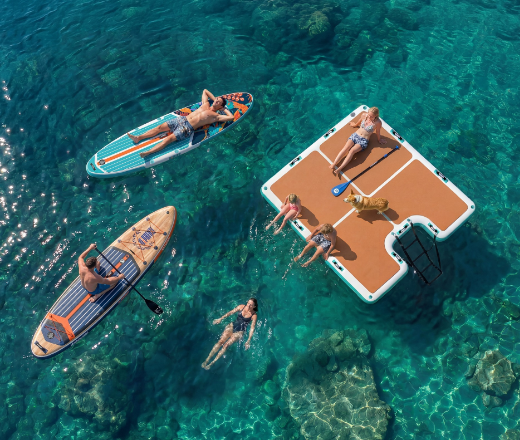
| Paddle with a dog | Stability, deck space, and enough capacity |
| Bring fishing or camping gear | Capacity and secure attachment points |
| Travel with your SUP | Manageable kit weight and compact packed size |
| Share a board with family members | Capacity and handling suited to each paddler |
For relaxed lake paddling, stability may matter more than speed. In its review of a 10′6″ Niphean board, OutdoorGearLab noted that its “stable platform makes us comfortable recommending it to beginners.” But beginners don’t all have the same needs: if you’re planning longer outings, consider a touring-oriented board with enough width for your stability needs, and compare its tracking and glide.
Consider Where You’ll Paddle
On calm lakes and sheltered water, prioritize stability and easy handling. For longer routes, compare tracking, which is how well the board holds its direction, and glide, which is how well it carries momentum between strokes.
For coastal paddling, consider wind, waves, currents, and boat traffic. Choose conditions that match your experience; a different board cannot replace skills or preparation.
Calculate the Load and Check Deck Space
Include your weight plus any passenger, pet, and gear you plan to carry.

Paddler + passenger or pet + gear = total load
Example: 180 lb paddler + 30 lb dog + 15 lb of gear = 225 lb.
A board may support that weight yet feel cramped. Compare capacity, stability, and usable deck space together, and follow the manufacturer’s guidance for the model. A maximum load rating is not a guarantee of comfortable paddling.
Before carrying a child or pet, check that the board is suitable for that use and plan appropriate safety equipment.
Choose the Size Around Those Needs
There is no universal beginner size. Your weight, height, experience, intended use, and gear all influence the choice.
An all-around board can balance stability and maneuverability for recreational beginners. A larger platform may suit a heavier load, while a longer board may suit distance paddling. Check width, shape, and capacity as well as length.
Extra length can make turning or transporting a board less convenient, so don’t size up without a reason.
Check Transport, Setup, and Storage
Consider the full routine: carrying and transporting the kit, inflating the board, and setting it up. Allow time to clean and dry the board before packing it away, following the manufacturer’s instructions.
Inflatable SUPs pack down for storage, but you still need to check total kit weight, bag size, inflation time, and space to dry the board. If the walk from your car to the launch is long, carrying comfort matters as much as packed size.
Check Inflation and Fin Setup
Once you have a shortlist, check the recommended inflation pressure and fin-installation steps for each model. Confirm that the pump and fin setup suit your routine, and follow the manufacturer’s instructions rather than choosing by the highest pressure rating alone.
Compare the Complete Cost
Check whether the package includes a paddle, pump, leash, fin, carrying bag, and repair kit. Compare their suitability too: an included pump or paddle may still need replacing if it doesn’t meet your needs.
Budget for a properly fitted life jacket and any other safety equipment appropriate for your conditions. Check that the leash is suitable for the water where you’ll paddle.
Compare the board price plus anything you still need to buy, not the board price alone. Check warranty details, return conditions, replacement-part availability, and access to customer support before buying.

Find the Board That Fits the Paddler
Choose for the water you’ll paddle, the load you’ll carry, and the setup you can comfortably manage. That gives you a practical shortlist, without paying for features you won’t use.
Niphean. Right on the Water.


Laissez un commentaire